Thursday, 19 September 2019

Culture and Nature

The content of the article linked below is, ultimately, distressing. By using harvest records from 664 years of grape-growing in the Bourgogne region of France, these researchers were able to determine that there has been a significant increase in temperature in the region - harvests are now happening 13 days earlier than the average for the previous 664 years. The most significant change has happened since the late 80's.

That is nearly half a month difference, and reflects some noteworthy warming.

And that is distressing. At some point, if unchecked, getting grapes to harvest in the Bourgogne is going to start becoming more and more difficult. 

But on the other hand, this study surprised me by also making me feel quite tender-hearted about the history of wine-growing and growers in this region. 664 years of families growing grapes and making wine is a long time. 664 years of knowing a landscape, working with the sun and seasons, predicting rainfalls. 664 years of integration between the economics, the politics, the culture, and the nature of this region.  The simple fact that grapes can still grow there at all is testament to conscientious farming practices - considering that the history of large-scale farming in the United States goes back only a couple hundred years - and the result has been massive top soil loss, mineral depletion, and post-war, with the full-scale implementation of corporate farming - ultimately the loss of small farms and the cultures that they created.

Too often we humans think of ourselves as separate. Different from the rest of nature in some essential way. Whether it is Biblical "dominion" or Cartesian "Dualism"--from the vantage of our cars or desks, it can be hard to feel anything but alienation from our planet. After all, our busy, frenetic, increasingly internet-and-media-focused lives even leave us alienated from each other and from our own bodies.

I've never been to the Bourgogne, but did visit Toulouse once for a Eco-Criticism conference at the university. After our first day, the whole group went out to eat at a local restaurant, where the chef was frustrated trying to find me (a vegan) something to eat, even commenting that the diet was "not very practical ..." (And by the way, the resulting pyramid of rice with sautéed vegetables was absolutely gorgeous). But the first thing we were served was a local liqueur mixed with a local sparkling wine. A traditional aperitif in Toulouse. It was golden and tasted like sunshine and earth fused on the tongue. It tasted like what I had imagined wine must be like when I was a kid. And there was a centuries long history to its production.  

Whatever concepts or devices may block the way - we are all made of Earth. Quite literally. 


This article (below) had the amazing effect of making me both hate and love human beings at the same time ... 664 years of harvest records for one wine-growing town in France ... and what they mean.

https://climatenewsnetwork.net/french-wines-show-hot-dry-years-are-now-normal/?fbclid=IwAR2bU9DRpZ1ui9liHGPNL5FTsmSfnXghxvw8GNLGn4BkA7_uYmrGt_e5MYo


Forest Fires and Carbon Emissions


It's been over a year since I posted anything on the blog. In a very practical sense, it doesn't really seem to exist anymore ... but I'm beginning to contemplate a resurrection.

To that end, I've been posting short little blurbs and news articles on FB the past week or so in the lead up to the Climate Strike this September and I thought, why not transfer some of these over to the blog as a start.

So here we go:

I've been seeing some interesting reactions around the net to the news of the fires in the Amazon. People saying "But the smoke will block the sun and slow global warming." Sorry - but trees are one of the most important ways for our planet to trap carbon (C02 is the top greenhouse gas we're worried about, followed by Methane). So not only are we losing the forests that act as filters and carbon-traps, but the smoke is full of carbon, therefore increasing the greenhouse gas in the atmosphere. Add to that that the main reason for the fires is to clear land for cattle grazing, and you also add in an increase in methane production as well. Article below about the importance of our forests.Here is a great article about the importance of our forests.

https://climatenewsnetwork.net/tree-loss-brings-more-warming-as-world-heats/?fbclid=IwAR1ktCxMNiQ_vknOkxill6PJOtN0PJJH5DQ8Xau-T1XCt1XMCdj12kVh5Es

And if you haven't signed on for daily updates from Climate News Network, I highly recommend it. I know that the stress of the endless flow of climate news can feel overwhelming - but they actually include good news stories, too, when they can be had.
x

Sunday, 17 June 2018

bodhi - The Paintings of Joan Watts


bodhi - The Paintings of Joan Watts

Its been a long while since I’ve touched the blog and it feels very appropriate that my first one back in business is to highlight the newest work of Santa Fe painter, Joan Watts.

An exhibition of Watts’ latest series of paintings, bodhi is up for another week or so at Charlotte Jackson Fine Art, in the Railyard (through June 26). This group of 20 paintings has a special place in my heart. I was honored to be invited up (Joan’s house and studio is up the hill from our apartment – I can see the edge of her house from my porch) to visit Joan and see the first three of the series almost two years ago. Joan and I talked, with the idea of me writing up an essay about her work and particularly its connection to Buddhism. As happens with me, I procrastinated and the article didn’t get written. In the end, though, this was fortuitous, as Joan invited me back up again to see the completed 20 paintings in the fall of 2017. She had named the series bodhi, and it turned out that this series, to my mind, is a perfect expression and encapsulation both of Joan’s skill and depth as an artist, but of the ways in which Buddhism and meditation infuse her work.

I wrote the essay and as it turns out, local art book publisher, Radius Books, accepted a proposal to create a special book featuring Joan’s work and my essay. The book will be coming out at the end of August and having seen the proofs I can say it will be beautiful. This is the kind of book that is a work of art in and of itself. (Here’s a sneak peak, here: https://www.amazon.com/Joan-Watts-bodhi-Michaela-Kahn/dp/1942185472/ref=sr_1_1?ie=UTF8&qid=1529256380&sr=8-1&keywords=bodhi+joan+watts; and here: https://radiusbooks.org/books/joan-watts-bodhi/).

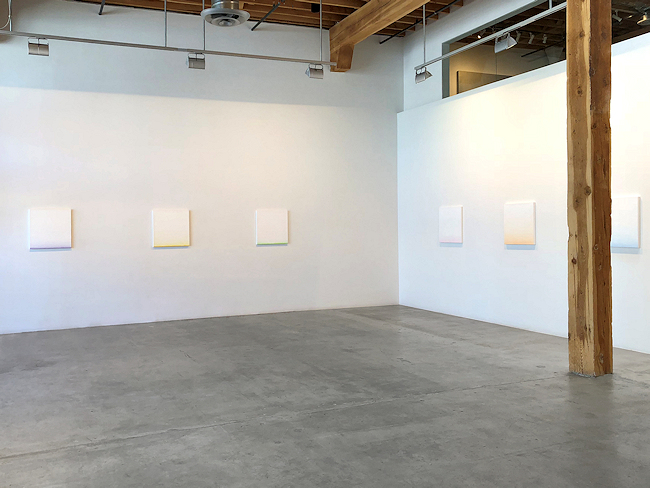
Walking through the gallery on the night of the opening, I was struck again by the power of these paintings. They are mostly white – only the faintest bit of color is anchored at the bottom of each piece, which rises and fades into pure white as it goes up. You can see the artist’s hand at work in the painterly waves across the surface. 

These are minimalist works and demand time, patience, and attention. They require that the person looking at them gives something of themselves to the viewing. Each piece held me for a while. As I stood there I could have sworn that I was on the precipice of understanding some strange unknown language speaking through them.

To give you a bit of a taste of bodhi and of my essay – I am including the press release I wrote for the show, which includes some excerpts from the essay. As we get closer to the book release date, I will circle back round with some more of the essay. And in the meantime I think a few articles about art, minimalist art, and maybe even how I came to write about it, may be in the offing.

Enjoy the images and if you’re in Santa Fe – go see Joan Watts’ bodhi in person!

From the press release:

Each painting is a breath.

Have you ever really felt a breath? Inhale. Slowly. Feel the texture of the air, cool through the nose, the slow expansion of belly, chest, throat. You are a three-dimensional being. You are connected to this invisible matrix that binds the world together. The world is inside you. Exhale, slowly. Chest falling, muscles letting go, the air leaving you, warmer now having taken a bit of your heat. You are falling outside yourself, released, part of the world. This is only the beginning of where the twenty paintings of the series, bodhi, by Joan Watts, are leading you.

After two and a half years when physical limitations prohibited Joan Watts from painting as she was used to, Watts discovered a new mode of working which has allowed her to create a new series. No longer able to spend whole days in her studio, Watts required a reduction of the elements and variables used in her process. Brushes had to go. Her use of saw-horses had to change. Drawing inspiration from the meditative practice of Japanese calligraphy – where a practitioner will create a complex character in a single elegant movement - calling on years of both artistic and meditative practice, Watts was able to adapt her method of working into a heightened state of concentrated effort.

In reducing her artistic process down to the bare essentials, Watts is, in effect, re-creating the experience of meditation on her canvases and panels. What is sitting meditation itself but a trimming down to essentials? Cut out the distractions, the extraneous noise. In the beginning, as meditation is often taught, the novice is told to merely follow her breath. In. Out. It is much harder than it sounds. Almost immediately thoughts, memories, emotions rise up. In meditation you are taught to recognize these thoughts and emotions and then let them go.

The paintings of bodhi strip away distractions. A single color, a square format, gentle textural waves, a subtle fade into white. These paintings enact and guide us toward a meditative possibility. With their rising and expansive movement, they have an ability (if we are willing to give ourselves over to it) to lead us back into our own body, our breath. Color on the canvas pools, rises and fades, like a thought or an emotion inside us: roiling in, shading our mind, and then, with our exhalation, the thought too disappears into white.

Watts’ work in bodhi is a gift of space and solitude, a small piece brought back from beyond and made tangible to lure us, to perhaps help show us how to make the journey for ourselves.

[[Credit for the photos goes to Charlotte Jackson Fine Art]]


Tuesday, 1 August 2017

Dead Zones and Dead Meat

Dead Zones and Dead Meat


Right now the average American eats 211 pounds of meat a year. And that voracious appetite not only is driving Climate Change, but is now leading to huge Dead Zones in the ocean. Here's an article about a vast dead zone in the Gulf of Mexico - created by the run off from animal agriculture. I know meat "tastes good". I know meat is "easy to cook". I know meat "has lots of protein". I know meat is familiar and comforting. But sometimes we have to do things that aren't 100% self-motivated. Sometimes we have to make choices with others in mind - because our planet is an ecosystem - and we are all a part of its web. We are all affected by the actions of others. We all rely on each other. We make this world, this reality together. All I am asking is that you take the time to reflect and consider whether you could take steps to reduce your meat consumption? How about Meatless Monday? Meatless Friday? If you're worried about nutrition or not knowing what to cook - hey, use me. I am happy to share resources and recipes from 25 years of being a vegetarian. And people who know me will tell you I am a pretty darn good cook. Mashed potato enchilada casserole anyone? Read the article. Give it some thought. Message me if you want a recipe. This is not about shame. And its not about someone trying to tell you what to do. This is about our planet, our oceans, the web of life.


And here is a recipe to start you out! 


Mashed Potato Enchilada Casserole


Okay, first off, apologies for lack of measurements here … I am not the best at writing down details of my recipes …

The sales pitch: I have yet to meet a person who didn’t like this recipe – or to make it for a dinner or party and not have people take seconds. Vegans, Vegetarians, and Meat-eaters alike have dug in with gusto on this one.


Mashed potato enchiladas break down into essentially 3 parts:

1.     The mashed potatoes
2.     The sautéed veggies you want to add
3.     The enchilada part

So first step:

1.     Make a pot of mashed potatoes. I usually make a largish pot full (lets say 2 to 3 pounds of potatoes depending on the size of your pan) cause I love them and if there are leftovers I am good with that. The worst is to be making your casserole and run out of taters!
2.     Only tip in terms of this recipe is to make them on the looser side, rather than too stiff. Nice and fluffy works best but not wet.
3.     Oh, and if you want to make them vegan not just vegetarian – its easy to just use some of the reserved potato cooking liquid instead of milk and use olive oil or vegan butter instead of butter. For an even bigger flavor boost – add a bit of veggie bouillon to the cooking water.

Mashed potatoes done.

Next step: sauté your veggies:

1.     I usually go for Mexican themed veggies – so red bell peppers, zucchini, corn … but I also sometimes like to add greens like spinach or kale and sometimes mushrooms. My sauté routine for these is a little oil, a little tamari (or soy sauce), some salt, pepper, a dash of cumin and paprika, and a squeeze of lime or lemon (if you have it).

Okay, veggies sautéed.

Now for the construction of the casserole and the enchilada part.

So pull together your ingredients and your pan.

I usually use a large deepish baking dish for these so I can get in a few layers.

So what you need for the construction is:

1.     Corn tortillas (be safe and go for two packages, depending on how many tortillas come in your pack).
2.     Your mashed potatoes
3.     Your veggies
4.     A can of black beans or pinto beans (drained and rinsed) – if you want to add a little extra protein to the mix. If you’re worried about needing more protein – go for 2 cans worth.
5.     Enchilada sauce (I buy canned and usually go for mild to keep it from overwhelming the flavors – but by all means get hot or make your own!). I don’t skimp on this – its key, so for a large casserole I can use as many as 3-4 cans of sauce!
6.     Black olives – if you want to get very Mexican restaurant about it
7.     Chopped fresh cilantro (ditto above).
8.     Regarding Cheeze. So one of the points of this recipe is that with the combo of the mashed potatoes and the sauce, you don’t really miss the cheese at all. BUT if you’re transitioning into eating less meat and dairy and don’t believe me – give a non-dairy cheese a try. For this recipe I recommend Daiya shreds. They melt like the real thing and taste excellent.

Construction: I go the casserole route because I think rolling tortillas is too hard. If you want the real thing – go for it!

For a casserole construction – I start with coating the bottom of the pan with sauce – just pour some in and spread it around with your fingers … cause why not? Then add a layer of tortillas – I try not to leave big open spaces and don’t mind overlapping. Next spread on a layer of mashed potatoes (I usually use a fork to get them semi-even), then a sprinkle of veggies, then beans, olives, cilantro or other toppings (Daiya if using) – now douse that in sauce. Repeat – tortillas, taters, veggies, toppings, sauce. Generally speaking, if I can manage to cram in 3 layers I am happy. But if you have a nice deep dish you can go more! I just try to eyeball my ingredients and the size of the pan and estimate how many layers and how deep I can go with each layer. End with a layer of tortillas and then sauce. Sprinkle the top with a little bit of Daiya or some olives if you’re not using the cheeze.

Bake, covered with tin foil, in about a 375 oven for about an hour. Its done when its hot and bubbling all through. Sometimes you need to test the very middle to make sure …

Let it sit for a couple minutes before digging in. I like to serve it with dollops of guacamole and a green salad.